
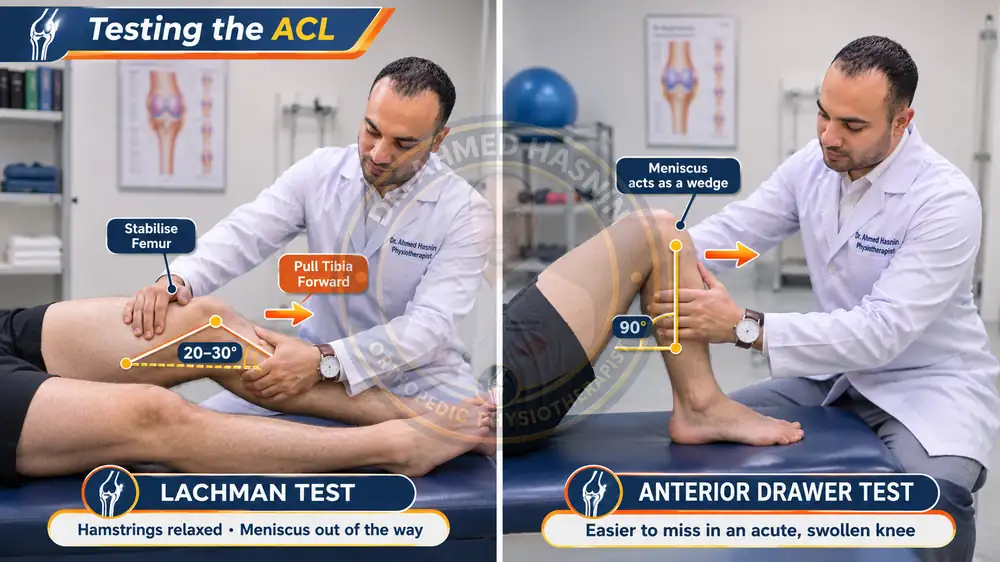
Both tests look for anterior translation of the tibia on the femur. The difference is the knee angle, and that changes how much you can trust the result.
Lachman: 20–30° of flexion
With the knee slightly bent, stabilise the distal femur and pull the proximal tibia forward. Judge both the amount of movement and the end-feel: a firm stop is normal, a soft or absent stop suggests a torn ACL. In this position the hamstrings are relaxed and the menisci do not block the movement.
Anterior drawer: 90° of flexion
In a painful, swollen knee the patient often cannot relax at 90°. Hamstring guarding holds the tibia back, and the posterior horn of the medial meniscus can act like a wedge. Both can give a false negative.
Clinical pearl
The Lachman is generally the most sensitive clinical test for an ACL rupture, especially in the acute knee. Always compare with the other side and pay attention to the end-feel, not just the amount of movement.
Have a question about your injury or a clinical case?
Send me your case, or keep learning with Orthomania Academy.